AGIBOT Releases GE-Act 2.0, Providing the First Systematic Validation of a Scaling Path for Native World-Action Models

【SHANGHAI, CHINA, September 10, 2026】AGIBOT today announced GE-Act 2.0, its new native world-action model (WAM), providing the first systematic validation of a scalable pretraining path for native world-action models.


GE-Act 2.0 addresses a fundamental question in embodied intelligence: as training data grows, can robot models continue to improve and unlock new capabilities in a way similar to large language models?


Unlike approaches that build on existing pretrained video-generation models, GE-Act 2.0 trains all of its model parameters—including visual representation, future prediction and action prediction—from random initialization on embodied manipulation data.


After pretraining, the same model is evaluated zero-shot, without task-specific fine-tuning, additional demonstrations or model replacement. The evaluation spans previously unseen scenes, backgrounds, lighting conditions and object instances, and covers instruction following, multi-skill manipulation and generalization to novel environments across 100 atomic tasks, 20 skill categories and two robot embodiments.


The results show that as training data scales 100×, from 300 to 30,000 hours, performance on existing skills improves while new capabilities progressively emerge. Tasks that models trained at smaller scales could not perform—including folding towels, nesting paper cups, uncapping and recapping pens, and arranging flowers—become achievable at larger data scales.


Together, the results provide systematic evidence of a scaling path for native world-action models.


Zero-Shot Evaluation Across 100× More Data Reveals a Clear Scaling Path
Additional task-specific training can improve benchmark scores, but it can also make it difficult to distinguish generalizable capabilities learned during pretraining from performance gained through task-specific adaptation.


GE-Act 2.0 therefore uses zero-shot performance as a key measure of pretrained capability. For the evaluation, AGIBOT used the same model without fine-tuning, additional demonstrations or model replacement, while ensuring that the test scenes, backgrounds, lighting conditions and object instances had not appeared in training.


Using the same training configuration, AGIBOT trained GE-Act 2.0 at four data scales—300, 1,200, 5,000 and 30,000 hours—and observed three clear scaling trends.


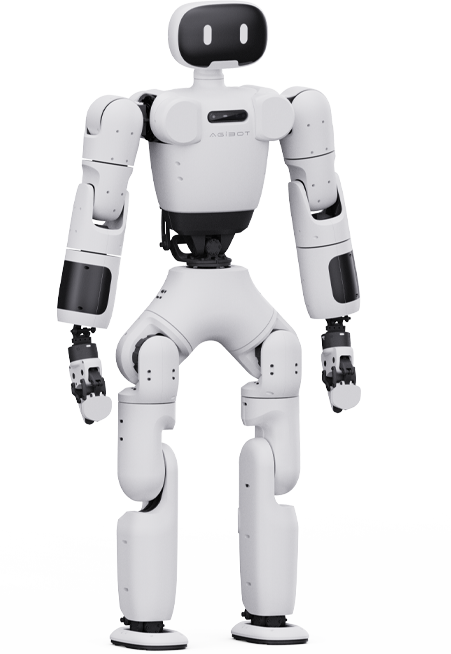
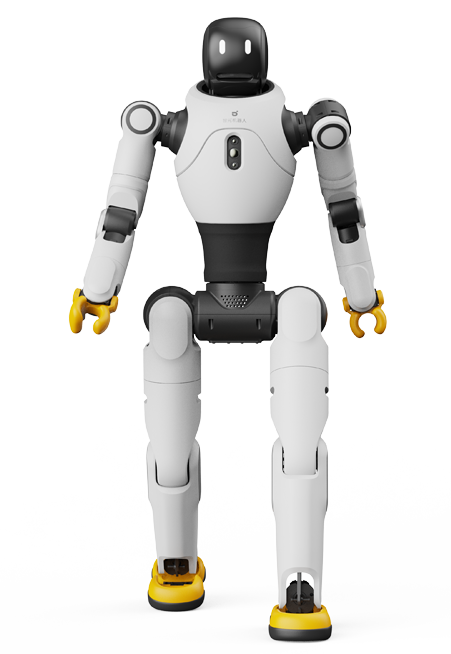
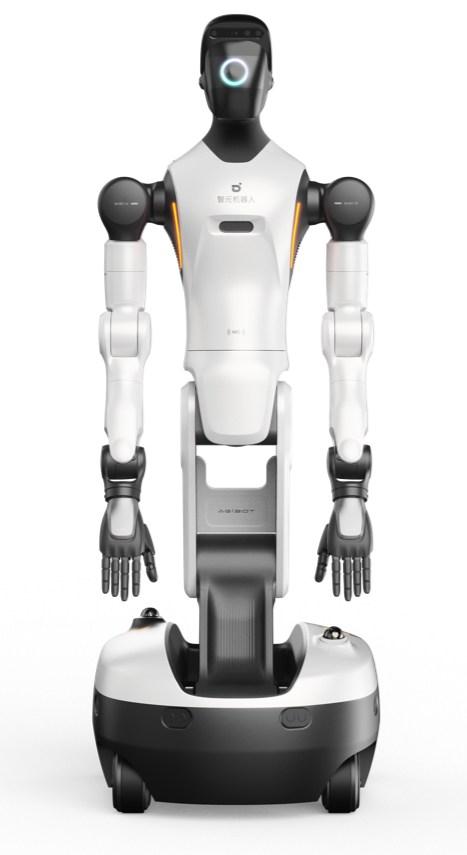
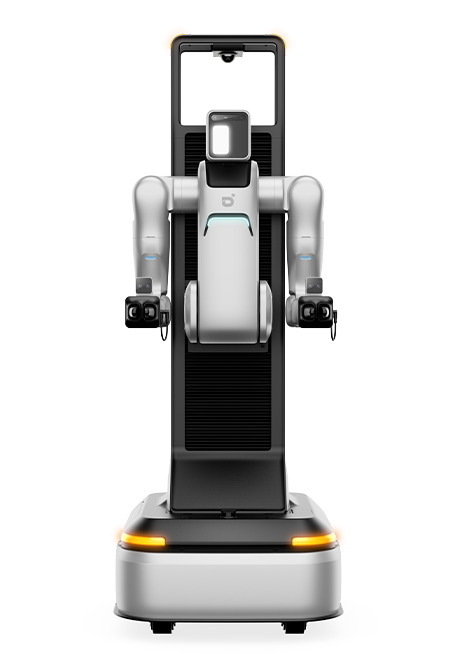
On G1-OP, the number of tasks with non-zero success rates increased from 39 to 76 as training data grew from 300 to 30,000 hours. On G2-90D, the number increased from 24 to 72. At larger data scales, the model also began to perform fine-grained manipulation tasks that models trained on smaller datasets could not successfully complete.


Overall task success rates also continued to improve. On G1-OP, the success rate rose from 17.1% to 44.1%, while G2-90D improved from 13.4% to 31.1%. Performance showed no clear sign of saturation as training data increased from 5,000 to 30,000 hours.


The results also provide evidence of cross-embodiment capability transfer. G1-OP accounted for more than 50% of the training data, while G2-90D represented less than 2%. Despite its limited representation in the training corpus, G2-90D's success rate improved by 17.7 percentage points as the shared dataset grew, indicating that capabilities learned from data-rich embodiments can transfer to embodiments with substantially less training data.


1789131830179693.png


As a complementary evaluation, fine-tuned GE-Act 2.0 achieved a 60.52% success rate on RoboTwin's unseen-environment test and scored 0.770 on the GenieSim instruction-following benchmark. In both evaluations, GE-Act 2.0 outperformed the other models evaluated, including π0.5 and GR00T N1.7.


1789131743610769.png


1789131782887723.png


A Native World-Action Model Built from Scratch for Robotics
Conventional action models generate actions based primarily on what a robot currently observes. A world-action model goes a step further: it first predicts how the world is likely to change, then uses that prediction to determine what the robot should do next.


Many existing world-action model approaches begin with pretrained video-generation models and add action-prediction capabilities afterward. This makes it difficult to determine how world prediction and action capabilities are jointly learned from embodied data.


GE-Act 2.0 takes a different approach. Its architecture is designed specifically for embodied manipulation and trained from scratch on embodied manipulation data, allowing world prediction and action learning to develop together within a unified framework.


Efficient Native Representation: Compressing Each Frame into 24 Visual Tokens
Robotic manipulation requires a model to capture objects, motion and local spatial structure while keeping computational costs manageable.


GE-Act 2.0 introduces a control-oriented autoencoder (CoAE) that compresses each 256×384 image frame into just 24 visual tokens—one-sixteenth the token count used by DINOv3—while retaining information relevant to semantics, motion and local structure.


Despite the substantially more compact representation, its performance in recovering action-relevant information remains close to information-rich representations such as DINOv3 and V-JEPA 2.1. In a controlled evaluation using more than 4,000 robot-manipulation samples, CoAE achieved 97.95% instruction-image matching accuracy, the highest among the five visual representations evaluated.


Native Visual Planning: Jointly Optimizing “Imagination” and “Action”
Within GE-Act 2.0, the world model predicts future states, while an inverse dynamics model (IDM) generates the corresponding robot actions.


Conventional approaches may require multiple rounds of computation to generate future states, increasing both compute and memory requirements and making joint optimization of world prediction and action more difficult.


GE-Act 2.0 instead uses single-step visual planning to generate a complete predicted future in one step. Action errors can then be propagated directly back to the world model, allowing future prediction and action generation to be optimized together.


Combined with its efficient visual representation, GE-Act 2.0 can generate a chunk of continuous robot actions in 104 milliseconds on an NVIDIA GeForce RTX 5090, enabling low-latency action generation.


KASO: Aligning Predicted Futures with Executable Actions
Real-world manipulation tasks often have multiple valid solutions. For example, a model might predict that an object should be grasped with the left hand, while a training demonstration uses the right hand. Both outcomes may be valid, but directly pairing one predicted future with a different demonstrated action can create a misleading training signal.


To address this issue, GE-Act 2.0 introduces Knowledge-Aligned Selective Optimization (KASO). The model generates multiple possible future states and selects the one most consistent with the demonstrated action for joint training.


This helps align what the model predicts with what the robot can actually execute. In out-of-distribution evaluations, KASO improved target-selection accuracy by 7.5 percentage points over the baseline and increased final grasping success by 10 percentage points.


Together, CoAE, single-step visual planning and KASO enable GE-Act 2.0 to connect “what happens next” with “what the robot should do next,” translating visual world prediction into executable robot manipulation.


Making Diverse Real-World Data Useful for Robot Learning
Scaling embodied models requires more than collecting successful robot demonstrations. Real-world robot training and deployment produce many different forms of data, including human manipulation videos, robot trajectories, deployment rollouts, corrections and failed attempts.


Traditional imitation-learning pipelines often rely on complete instruction-video-action pairs, leaving large amounts of real-world data difficult to use. GE-Act 2.0 is designed to assign different forms of data to different learning objectives.


The world model is pretrained on 39,000 hours of instruction-video data, allowing it to learn how environments and objects change over time. This dataset includes 3,000 hours of embodiment-free data, such as egocentric and human-manipulation videos without robot action labels.


The inverse dynamics model is pretrained on 32,000 hours of robot trajectories, learning which robot actions correspond to observed changes in the visual world. These trajectories include 2,000 hours of failed manipulation attempts and real-world deployment rollouts, without requiring success labels.


Finally, the two capabilities are connected through joint training on 30,000 hours of complete instruction-video-action data.


Because the inverse dynamics model can recover action supervision from robot trajectories, data without complete language instructions or success labels—including failed interactions—can still provide useful learning signals. This expands the range of real-world experience that can contribute to embodied pretraining and turns data that might otherwise be discarded into useful training assets.


1789131655114923.png

GE-Act 2.0 learns from diverse real-world data, including embodiment-free videos, robot trajectories, deployment rollouts, and both successful and failed interactions.


GE-Act 2.0 provides systematic evidence of a scalable pretraining path for native world-action models. As embodied training data grows, performance improves, new skills emerge and capabilities can transfer across robot embodiments.


Together with GE-Sim, AGIBOT's model for policy evaluation and environment construction, GE-Act 2.0 advances the company's broader GE world-model framework from predicting and simulating the world toward acting within it. GE-Sim supports policy evaluation and environment construction, while GE-Act turns future prediction into real-world robot manipulation capabilities.


As a broader range of embodied data becomes usable within a unified training framework, and zero-shot capabilities continue to improve with increasing data scale, the scaling path toward embodied foundation models is becoming increasingly clear.


For more information, please visit AGIBOT.com and follow AGIBOT on:
X: https://x.com/AGIBOTofficial
LinkedIn: https://www.linkedin.com/company/agibot/
YouTube: https://www.youtube.com/@AGIBOTofficial
Instagram: https://www.instagram.com/agibotofficial/
TikTok: https://www.tiktok.com/@agibotofficial
Facebook: https://www.facebook.com/AGIBOTofficial/


About AGIBOT

AGIBOT is a pioneer in the global general-purpose AI robotics industry, with its core technology focused on embodied AI. AGIBOT's "Three Intelligences in One" architecture integrates Locomotion Intelligence, Interaction Intelligence, and Manipulation Intelligence into a unified embodied system. Its portfolio spans humanoid robots, quadrupeds, dexterous systems, and commercial cleaning solutions. In June 2026, AGIBOT announced that its 15,000th robot had rolled off the production line.